.png)


Ankle Mobility Exercises: Why Calf Stretching Isn’t Enough
Your heels lift before you reach the bottom of a squat. One ankle feels less cooperative when you walk downstairs. In a lunge, your front knee stops moving forward even though the rest of your body seems ready to continue.
These are common reasons people start looking for ankle mobility exercises, and usually end up doing the same calf stretch every day. Calf stretching can be useful, but the ankle also has to move with the knee in different positions while the foot stays controlled underneath you.
If your usual calf stretch is not changing the way your squat, lunge, or stride feels, the answer may not be to pull harder. A more complete approach lets the ankle move in different positions and directions.
What Ankle Mobility Actually Means
Ankle mobility is your ability to move the ankle through the range required for an activity while maintaining control. It is not simply how far the joint can move or how flexible your calves are. Useful mobility also depends on whether you can keep the foot stable and control the available range while standing, walking, squatting, or exercising.
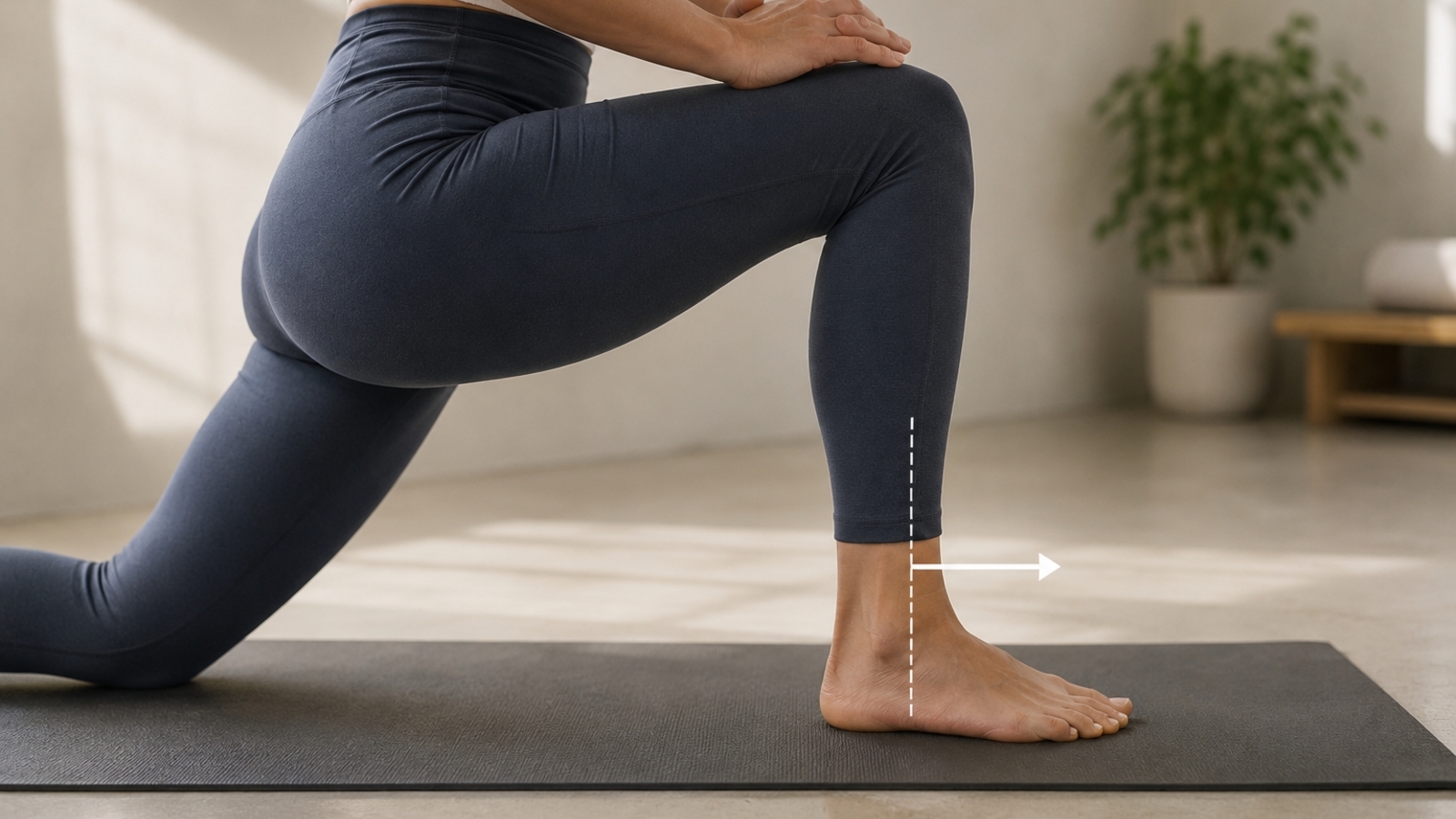
The ankle and foot move in several directions: the foot can point, draw toward the shin, and tilt from side to side. When people describe a “stiff ankle,” however, they are often talking about limited dorsiflexion. This is the movement that brings the top of the foot closer to the shin. When the foot is planted, dorsiflexion looks like the shin and knee moving forward while the heel stays on the floor.
You use this motion when you walk, descend stairs, squat, lunge, run, and land. It does not look identical in every body: limb proportions, footwear, squat depth, and mobility elsewhere all influence the final shape.
If dorsiflexion is limited, you may notice the heel lifting, the foot turning outward, or a squat or lunge stopping earlier than expected. These signs are useful clues, but they do not prove that the ankle is the only issue. Research has linked lower weight-bearing dorsiflexion with different ankle and knee movement during squats (Dill et al., 2014). This does not mean it automatically causes pain or injury, only that more comfortable, controlled range may make some movements feel less restricted.
This is why ankle mobility work may involve more than holding a calf stretch. The goal is not only to increase range, but to develop range you can control and use in different positions.
Why Calf Stretching Alone May Not Be Enough
The calf is not one single muscle. The familiar wall stretch with the back knee straight places the gastrocnemius—the larger, more visible calf muscle—in a lengthened position across both the knee and ankle. Bending the knee changes the position and places more emphasis on the soleus underneath.
Both variations can be useful because everyday movements do not keep the knee in one position. Squats, stairs, and many lunges require ankle dorsiflexion with a bent knee. If every calf stretch you do keeps the knee straight, you may never explore the position that feels limited.
The restriction may not be mainly muscular. Calf or Achilles stiffness can play a role, but joint mobility, previous injuries, individual anatomy, and other tissues may also affect dorsiflexion. A 2025 clinical perspective emphasizes identifying the source before choosing a targeted rehabilitation approach (Tourillon et al., 2025).
You do not need to diagnose it yourself. The practical takeaway is not to assume that more pressure in the same stretch will solve every limitation. A broad calf stretch is different from sharp pain, a hard block, or persistent pinching at the front of the ankle. Reduce the range and speak with a healthcare professional if those sensations continue.
Range also has to be controlled. Slow heel movement and small motions in more than one direction can help you use the range you have. This is the same principle discussed in our guide to balancing mobility and strength.
Three Ankle Mobility Exercises From STRETCHIT
The following exercises are adapted from Ankle Express 1 and Ankle Express 2 with STRETCHIT trainer Alicia Archer. Move slowly, stay within a comfortable range, and stop if you feel sharp pain, pinching, or nerve-like sensations.
1. Seated Heel Lifts
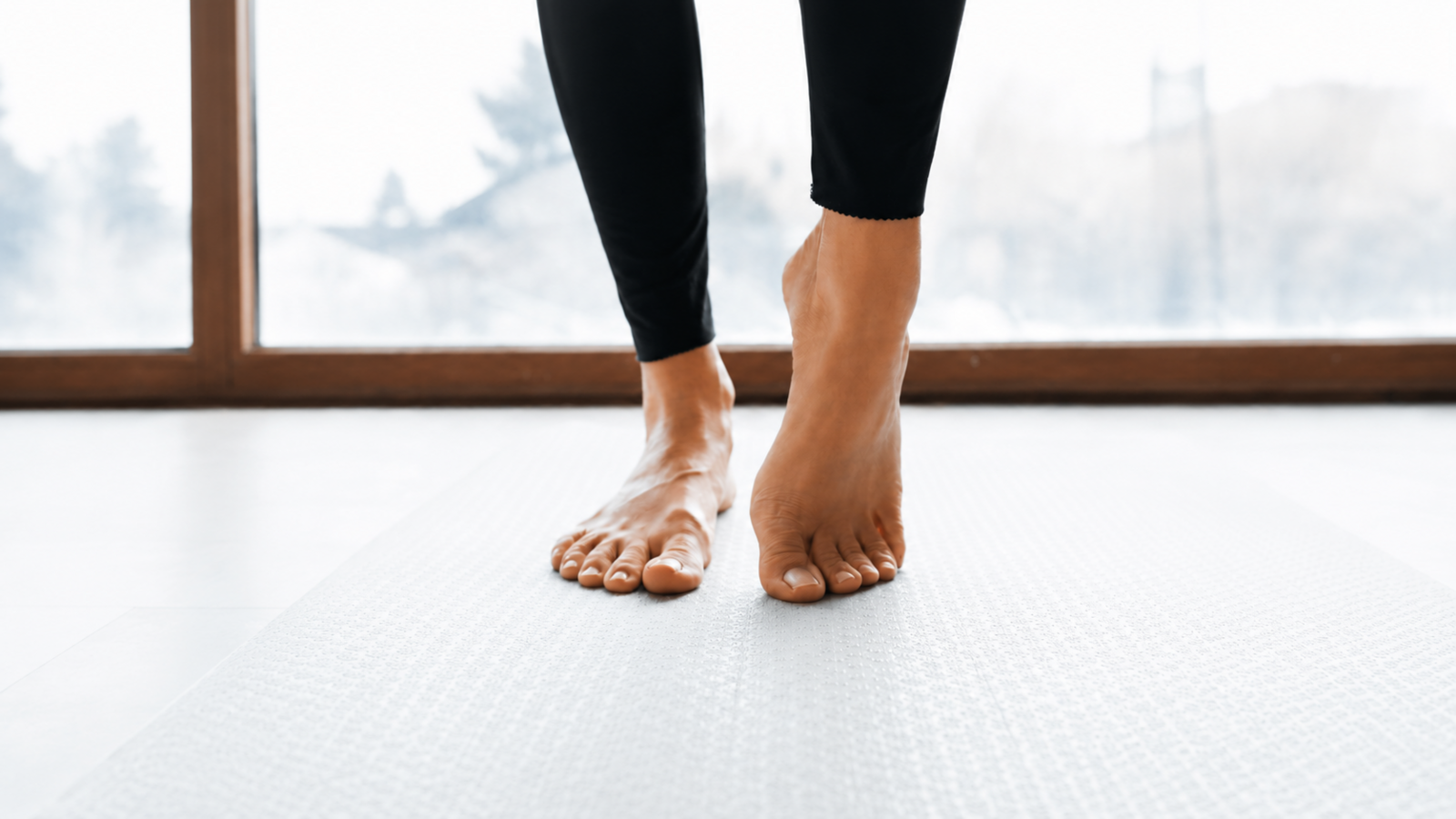
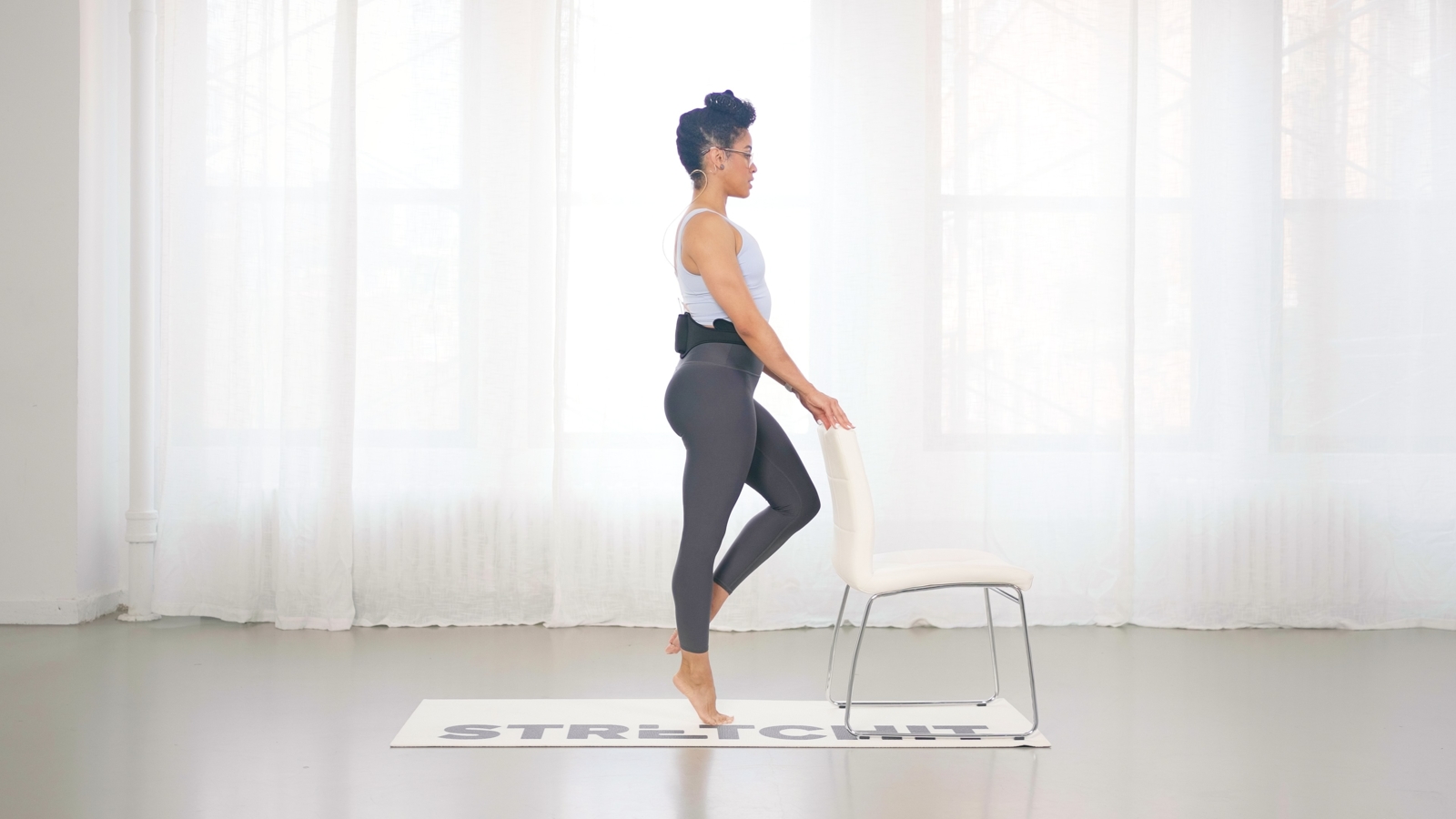
Sit comfortably with one foot planted on the floor. Slowly lift and lower the heel five times while keeping the foot centered. As the heel rises, allow the arch to move forward, but avoid rolling the foot noticeably toward its inner or outer edge. You can lightly hold the heel with one hand to feel and guide its path.
The seated position makes it easier to notice how the heel and arch work together before you add more body weight.
2. Supported Heel Lowering in a Deep Knee Bend
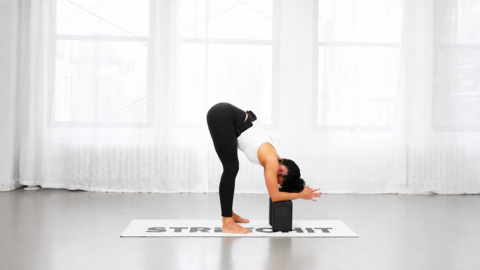
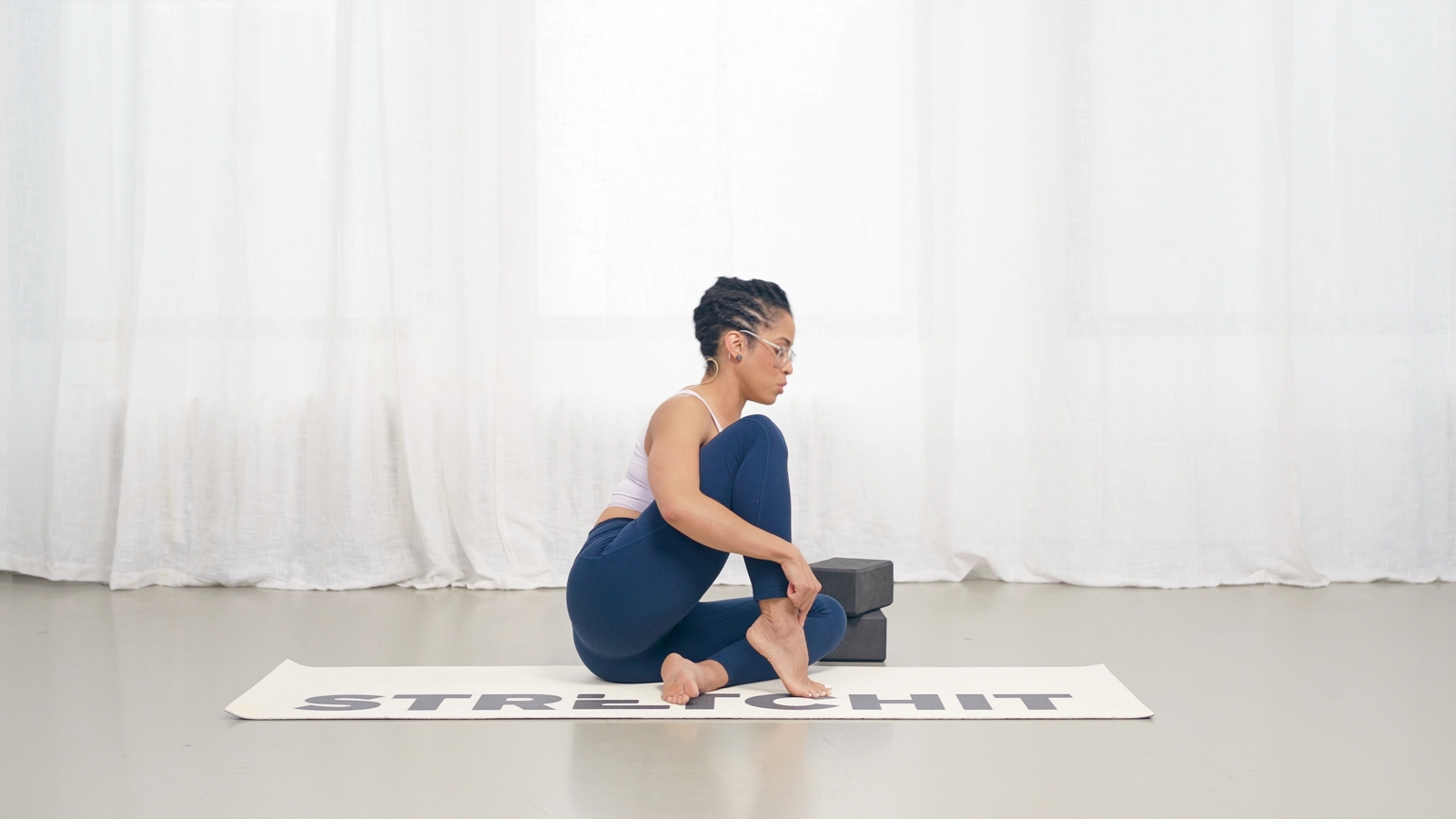
Place your hands on yoga blocks or a sturdy piece of furniture. Begin in a supported forward fold with your knees bent. Lift both heels and lower your hips into a comfortable knee bend. Keep the knees facing forward as you gradually lower the heels toward the floor.
Raise the heels before lifting the hips and returning to the start. Repeat three to five times. Your heels do not need to touch the floor; only lower as far as you can without losing control or feeling a pinch.
This explores dorsiflexion with bent knees, making it more closely related to squats and stairs than a straight-knee calf stretch alone. If you feel knee pain or instability, stop rather than trying to work through it.
3. Seated Side-to-Side Ankle Control
Sit with one leg extended in front of you. Keep the knee and shin as still as you comfortably can. Gently tip the foot toward its outer edge, return to the center, and then tip it toward the inner edge. Perform four or five slow repetitions in each direction.
Keep the movement small enough that it comes mainly from the ankle instead of rotating the entire leg. The foot and ankle also need control in directions beyond dorsiflexion.
Where Calf Stretching Still Fits
None of this means you should stop stretching your calves. A systematic review found that stretching can improve ankle dorsiflexion, although the size of the change varies across methods and populations (Young et al., 2013).
If calf stretching feels comfortable, include both a straight-knee and a bent-knee variation with the heel grounded. The stretch should feel clear through the back of the lower leg, not sharp or pinching inside the joint. You can also pair ankle mobility with foot-strengthening exercises for better control through the whole foot and ankle.
The aim is to combine comfortable range with control, then notice whether walking, stairs, squats, lunges, or sport begin to feel less restricted.
When to Stop and Seek Professional Guidance
This article is general educational information, not medical advice. Do not treat significant ankle pain as a flexibility problem to push through.
Speak with a healthcare provider if the problem followed a recent injury, the joint is swollen or visibly changed, pain is severe or getting worse, you cannot walk normally, or you experience tingling or loss of sensation. Persistent front-of-ankle pinching, repeated giving way, or a major difference between sides after an old sprain or fracture also deserves individual assessment.
Key Takeaways
- Ankle mobility often refers to dorsiflexion: the shin moving forward over a grounded foot.
- Calf stretching can help, but it cannot address every reason an ankle feels restricted.
- Straight-knee and bent-knee calf stretches place the lower leg in different positions.
- Controlled heel movement and side-to-side ankle work can complement calf stretching.
- Sharp pain, persistent pinching, or a hard block is a reason to stop forcing the range.
Get Started with STRETCHIT
If ankle mobility is limiting your squats, lunges, stairs, or other lower-body movements, guided practice can help you explore the range with more structure.
In the STRETCHIT app, try Ankle Express 1 and Ankle Express 2 with Alicia Archer. The classes combine supported ankle flexion and extension, controlled heel movement, and exercises that take the ankle through more than one direction.
Get started with STRETCHIT and choose a guided class that matches your current mobility and experience.
Resources
- Tourillon, R., M’Baye, M., & Smith, M. “Restoring Ankle Dorsiflexion Range of Motion in Athletes: An Individualized Clinical Decision-Making System.” Frontiers in Sports and Active Living, 2025.
- Young, R., Nix, S., Wholohan, A., Bradhurst, R., & Reed, L. “Interventions for Increasing Ankle Joint Dorsiflexion: A Systematic Review and Meta-Analysis.” Journal of Foot and Ankle Research, 2013.
- Dill, K. E., Begalle, R. L., Frank, B. S., Zinder, S. M., & Padua, D. A. “Altered Knee and Ankle Kinematics During Squatting in Those With Limited Weight-Bearing–Lunge Ankle-Dorsiflexion Range of Motion.” Journal of Athletic Training, 2014.
- National Health Service. “Ankle Pain.” NHS.