.png)


Why Is One Side More Flexible Than the Other?

Why Is One Side More Flexible Than the Other?
You finish stretching your right leg and switch to your left. Same exercise, same mat, same you. Somehow, this side feels completely different.
Maybe you can fold comfortably over one leg but barely move over the other. Maybe your right front split is getting closer to the floor while your left one seems to have missed the memo. It’s tempting to label one side your “good side” and start working twice as hard on the other.
Before you do, take a closer look at what you’re comparing. A difference between sides can tell you something useful about your training, but it doesn’t automatically mean anything is wrong.
Why your sides may feel different
You don’t move through the day in perfectly equal ways. You might lead with the same leg when climbing stairs, stand with more weight on one hip, or favor one side in a sport. Previous training, injuries, and differences in how your joints move can also shape what each side feels like in a stretch.
And then there’s the day you’re having. If you trained your legs yesterday, slept poorly, or rushed through your warm-up, one side might feel less cooperative than usual.
The important question isn’t simply, “Which side goes farther?” It’s what happens when you give both sides the same setup.
Make sure you’re comparing the same stretch
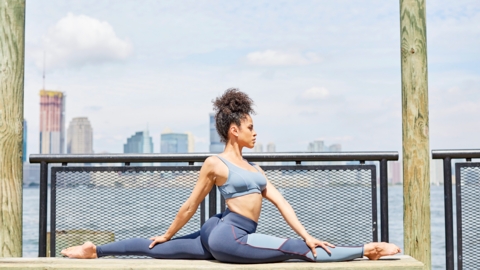
Let’s use a front split as an example. You put your right leg forward, lower toward the floor, and notice where you stop. Then you switch legs. The left side feels much harder.
Now check the details. Are your hands supported at the same height on both sides? Are you turning your hips more on one side? Are you bending one front knee but keeping the other straight? A small change in position can make a large difference in how the stretch looks and feels.
Try this during your next session:
- Warm up first. Walk, move gently, or follow the warm-up in your class before comparing your range. The American Academy of Orthopaedic Surgeons recommends warming up before hip exercises.[1]
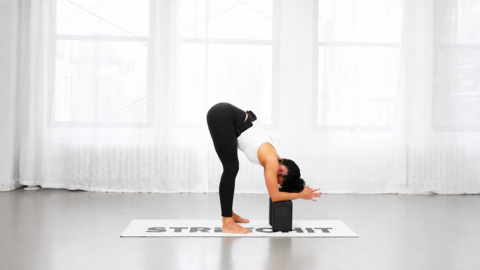
- Use the same position on each side. In a supported half split or low lunge, keep your hands on blocks if you need them. Move slowly and stop at a comfortable stretch rather than your deepest possible position.
- Notice more than depth. Does one side need more support? Can you stay steady and breathe? Does the sensation change when you slightly adjust your stance?
You can take a photo from the same angle on each side, but don’t turn every session into a test. Photos are most useful when the setup stays consistent and you compare them over time.
If you’re not sure which positions to photograph, STRETCHIT trainer Alicia Archer demonstrates several ways to track flexibility progress, including a low lunge. She shows what to look for in each position so you can take a photo now and return to the same position after several weeks of training. Watch Alicia’s tutorial on measuring progress.
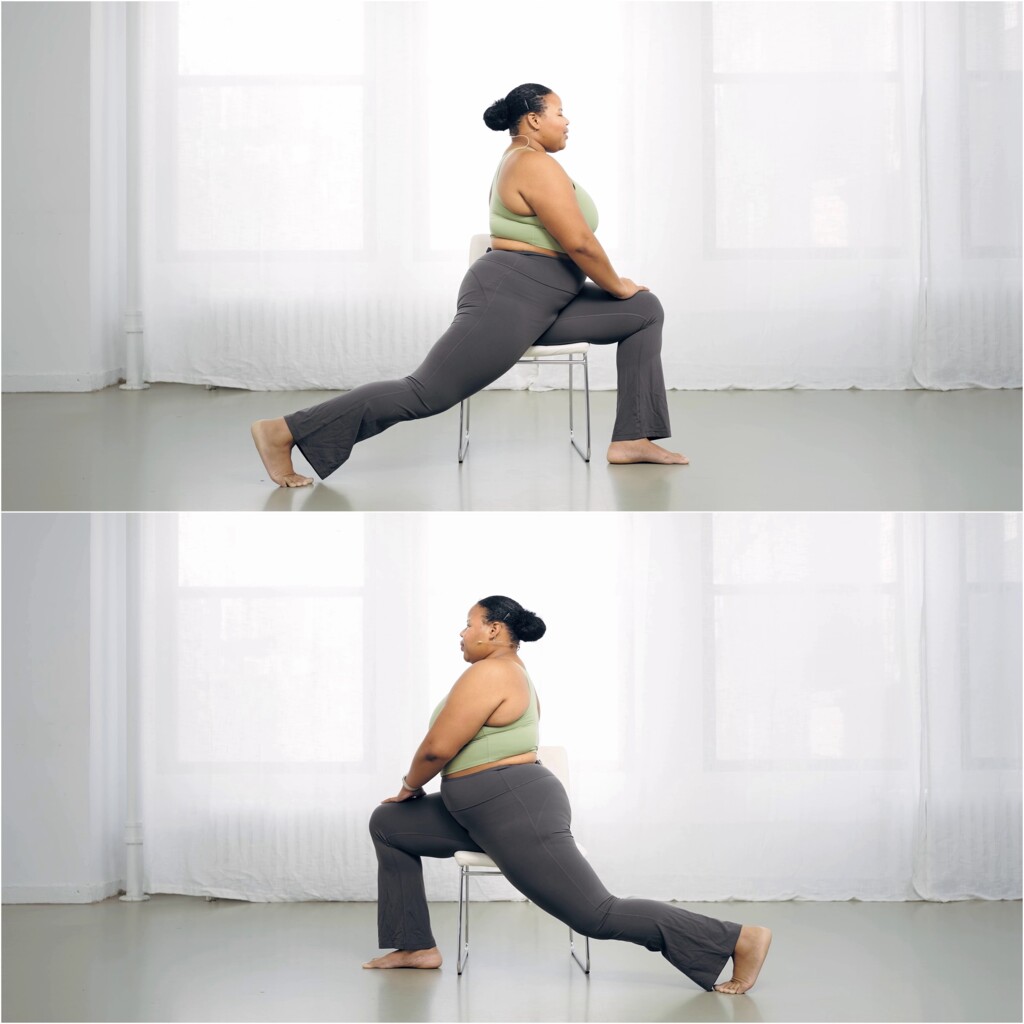
Should you spend more time on the tighter side?
Keep practicing both sides. If you only train the side that feels restricted, the comfortable side misses out on strength and control. If you always push the restricted side to match the other, you may end up forcing a position it isn’t ready for.
Instead, let each side work within its own comfortable range. That might mean using a block on one side and a taller block on the other. It might mean holding a smaller lunge while you learn to control the position. Equal effort does not have to produce identical shapes.
If one side consistently feels harder, you can give it a little more attention with an additional gentle repetition. Keep the movement controlled, and see how you feel afterward. More intensity isn’t necessarily the answer. Research has found that resistance training can also improve range of motion,[2] so building strength through a range you can control belongs in the conversation alongside stretching.
For front splits, that could mean practicing a supported lunge and a hamstring stretch on both sides, then doing a small amount of controlled leg work. Follow the level appropriate for you in your STRETCHIT classes rather than trying to pull one leg farther into a split.
Do both sides need to become identical?
No. You can make progress without making your left and right sides look exactly alike.
A more useful goal is to move with control on both sides and notice whether the difference affects what you want to do. Perhaps your left split gradually becomes steadier, even though it remains higher than your right. That is progress. Perhaps you discover that your “tight” side simply needs a different amount of support to practice the same exercise well.
This is especially helpful if you’re working toward a front split. As we explain in our front splits guide, the position asks for movement at both the front and back of the hips. What looks like one stubborn leg isn’t always solved by stretching that leg harder.
When to stop and ask for help
A familiar, painless difference between sides is one thing. A new restriction after an injury, pain in a joint, numbness, or a sensation that persists or worsens deserves individual attention. Stop the exercise and speak with a healthcare professional rather than trying to stretch through it.
That’s particularly important if your knee hurts. Don’t use a deeper stretch to test whether the pain will go away. If the only issue is pressure from the floor in a kneeling position, a folded mat or cushion may make the position more comfortable. Pain inside the knee needs a professional assessment.
Get Started with STRETCHIT
STRETCHIT classes give you a structured way to practice both sides while building flexibility and control. Choose a class that matches your level, use blocks when you need support, and pay attention to how each side feels rather than trying to make them look the same. Explore STRETCHIT classes.
Your sides may never tell exactly the same story. Listen to both of them anyway. The aim is to train each side consistently, use the support it needs, and let progress come from practice rather than pressure.
This article is for general education and is not medical advice. If you have pain or concerns about an injury, speak with your healthcare provider.
References
- American Academy of Orthopaedic Surgeons. Hip Conditioning Program.
- Alizadeh S, et al. Resistance Training Induces Improvements in Range of Motion: A Systematic Review and Meta-Analysis. Sports Medicine. 2023.