.png)


Can't Touch Your Toes? Your Hamstrings May Not Be the Only Reason
You fold forward, reach toward the floor, and your hands stop somewhere around your shins. The person next to you places both palms down without seeming to try. The obvious conclusion is that their hamstrings are flexible and yours are not.
But touching your toes is not a pure hamstring test. A forward fold combines movement at the hips, pelvis, spine, knees, and ankles. Your technique and body proportions also affect how close your fingers get to the floor.
Instead of pulling harder on the backs of your legs, you can make the position more accessible and work on the parts that actually feel restricted.
What Actually Happens When You Touch Your Toes?
In a forward fold, your pelvis tips over the tops of your thighs as your hips flex. Your hamstrings lengthen across the backs of the legs, your spine contributes to the shape, and your calves may add tension when your knees are straight and your ankles are flexed. Reaching the floor also depends on the relative length of your arms, torso, and legs.
This is why two people with similar hamstring flexibility may have different-looking toe touches. A meta-analysis found that sit-and-reach tests had only a moderate relationship with hamstring extensibility and a low relationship with lumbar extensibility (Mayorga-Vega et al., 2014).
Your toe touch can still help you notice changes in your own body. It is not a universal pass-or-fail test of flexibility, and it cannot identify exactly what limits the movement.
Why Your Hamstrings Can Feel Tight
When you feel a strong pull behind your thighs, it is tempting to imagine that the muscles are physically too short. The sensation may instead reflect stiffness, your current tolerance for the stretch, fatigue, or simply a position your body does not practice often.
A 2025 systematic review found that improvements after static stretching were associated with both reduced stiffness and greater stretch tolerance. The researchers did not find evidence that static stretching simply made muscle fibers longer (Ingram et al., 2025).
This helps explain why your range can change from one session to another. You may reach farther after warming up and feel more restricted after a hard leg workout or inadequate recovery. Your readiness to use the range changed.
The practical lesson is simple: treat tightness as information, not as a command to stretch harder.
Bending Your Knees Is Not Cheating
Many people turn a forward fold into a contest to keep the knees perfectly straight. Then the pelvis stops moving, the back rounds aggressively, and the hands still do not reach the floor.
A small bend in the knees reduces the demand on the hamstrings. That may give your pelvis more room to tip forward so you can feel how the fold begins at the hips. You can gradually straighten the legs as the position becomes more comfortable.
The same applies to props. Yoga blocks or a chair bring the floor closer and let you support your weight instead of forcing range you do not yet have.
Three Forward-Fold Exercises to Try
These exercises use the alignment and modification principles taught in STRETCHIT's Forward Fold Variations, Pike Stretch, and Hamstring Express classes. Move slowly and look for a clear, manageable stretch rather than the deepest possible shape.
- Supported Bent-Knee Forward Fold
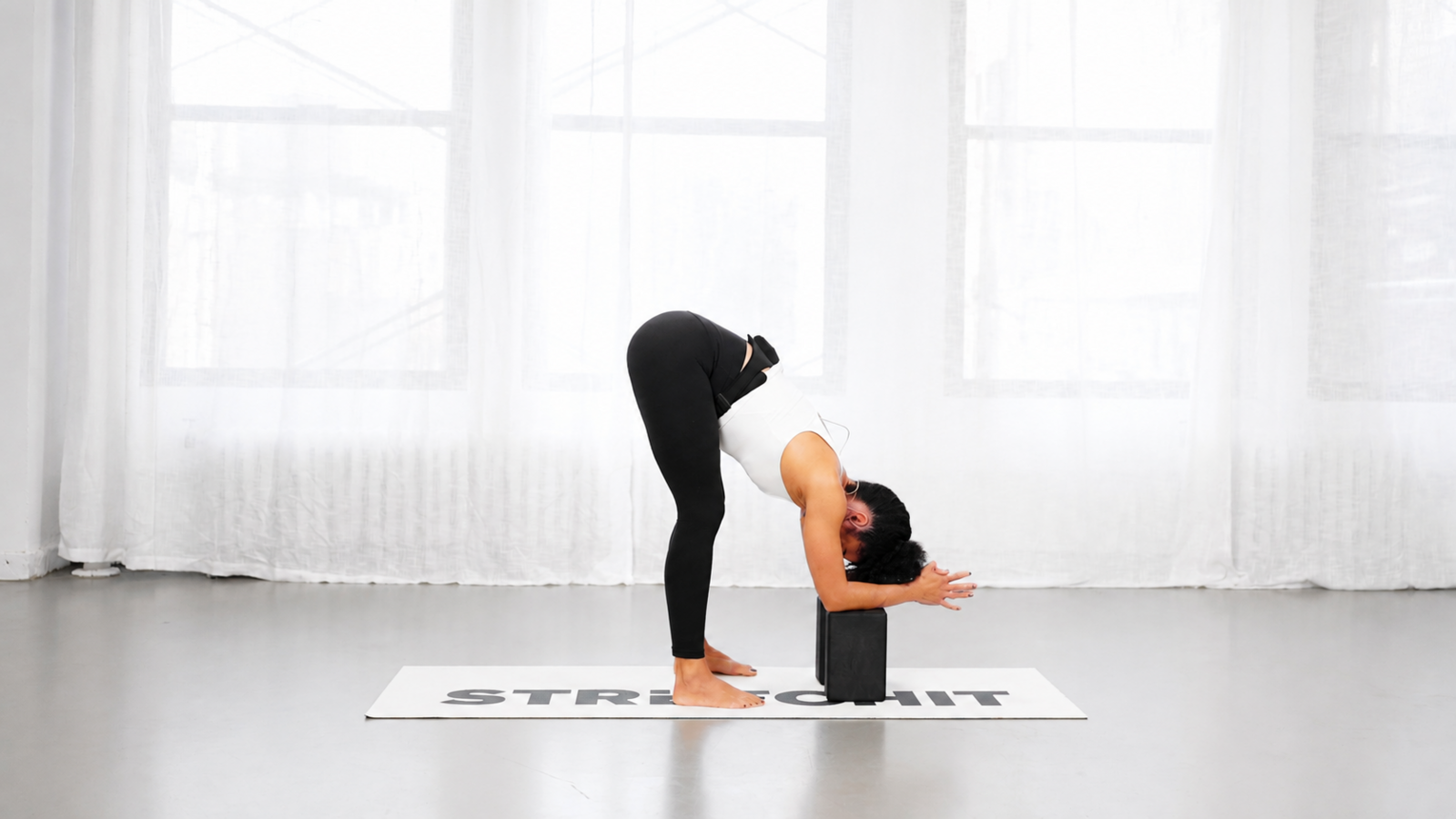
Stand with your feet about hip-width apart and place two yoga blocks or a sturdy chair in front of you. Bend your knees and rest your hands on the support. Send your hips back slightly, then tip your pelvis forward and let your torso follow.
Keep enough bend in the knees to feel supported. If comfortable, slowly straighten the legs until you feel a gentle stretch along the backs of the thighs. Stop before the knees lock or the sensation becomes sharp. Stay for three to five slow breaths, then bend the knees before standing up.
This variation helps you find the forward movement of the pelvis without making the floor the goal.
- Elevated Seated Pike
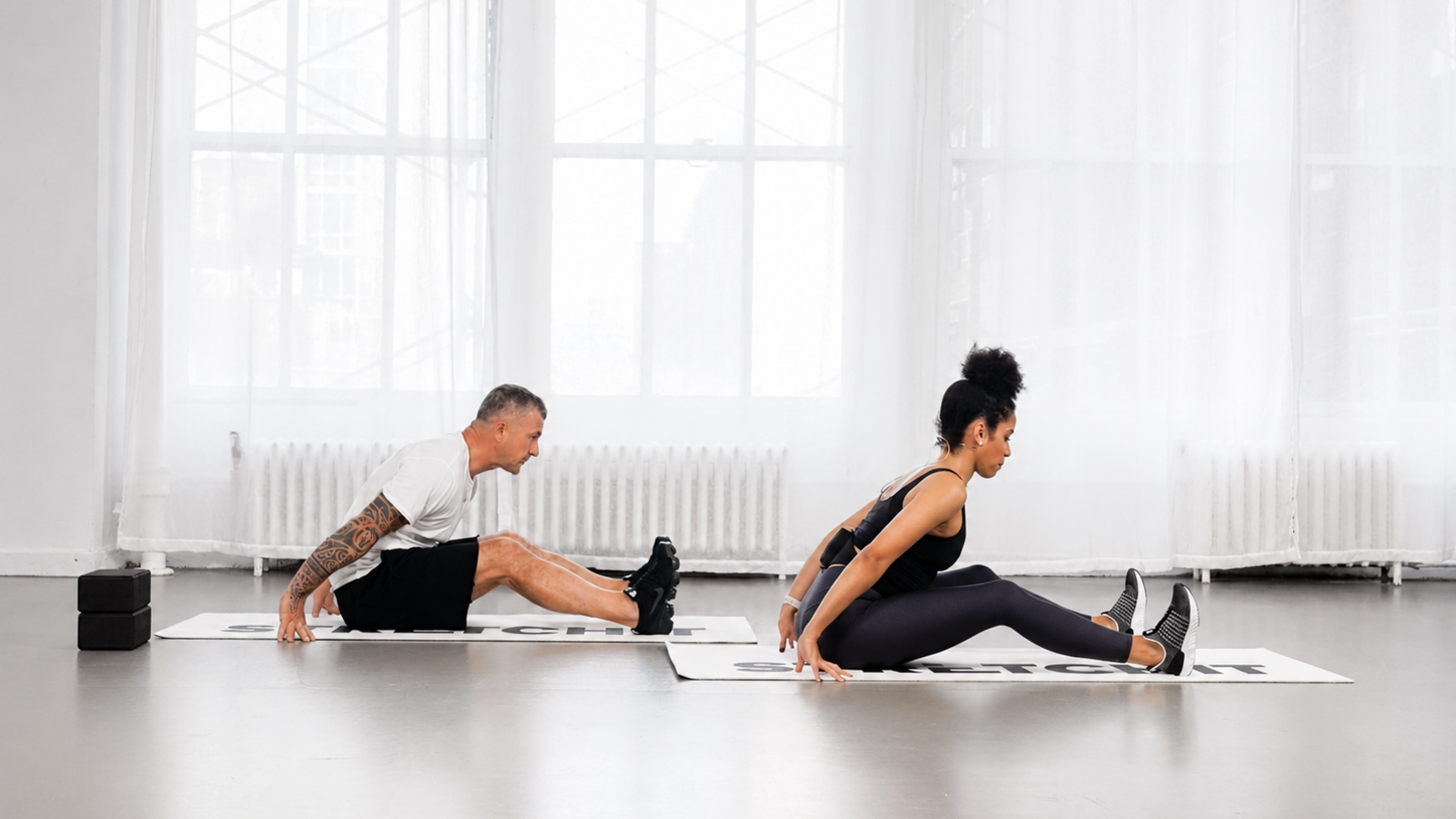
Sit on a folded blanket, firm cushion, or low yoga block with both legs extended. Bend the knees slightly if sitting upright already creates a strong pull. Place your hands beside your thighs or on blocks.
Lift through the chest and begin to tip forward from the hips. Think about moving your lower belly toward your thighs rather than pulling your head toward your knees. Keep the range small enough that you can breathe without gripping. Hold for three to five breaths, then return upright.
Raising the hips can make it easier for the pelvis to move forward, especially if you feel stuck before the fold has really started.
- Strap-Assisted Pike
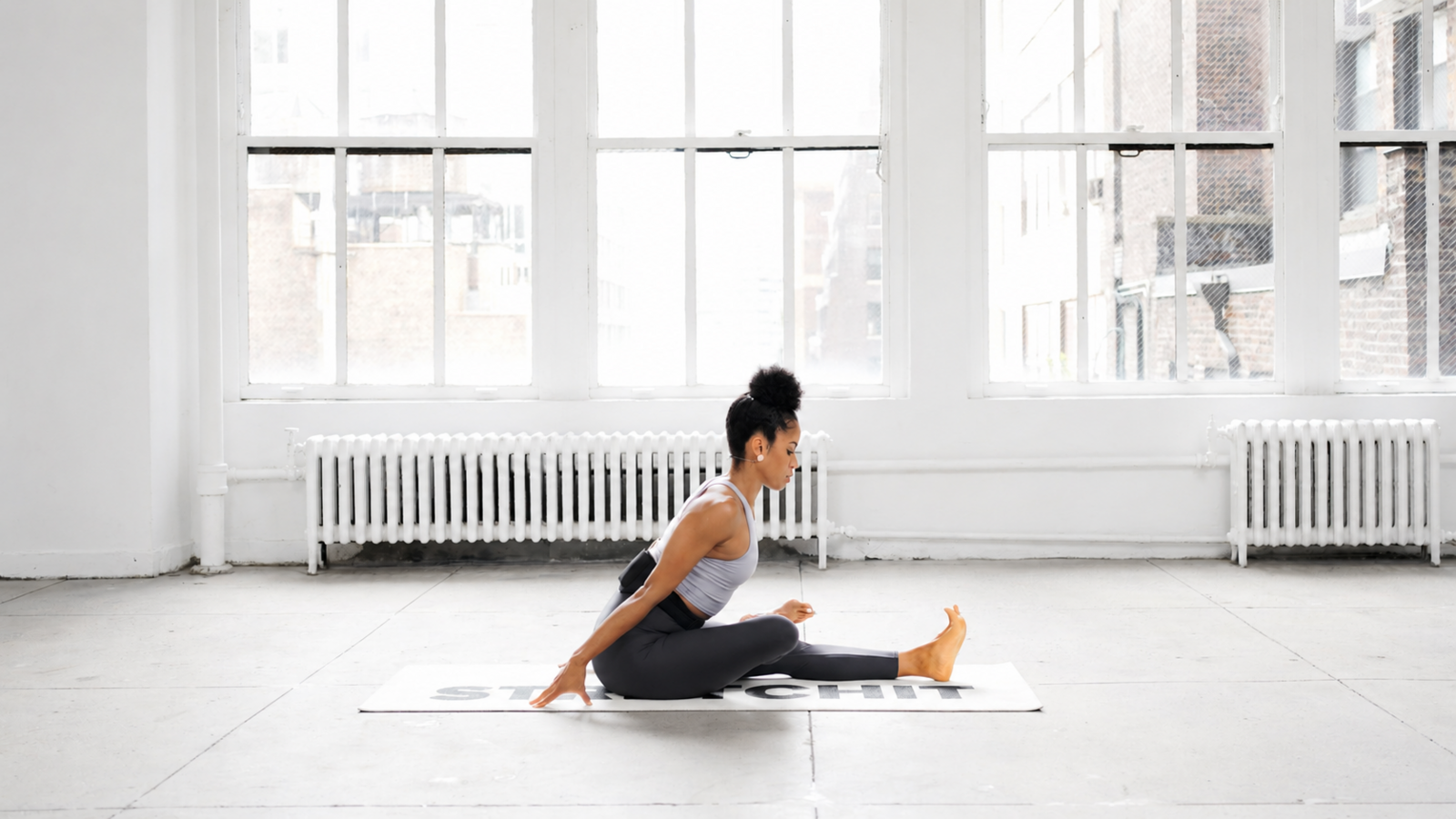
Sit with your legs extended and loop a yoga strap, towel, or belt around the balls of your feet. Hold one end in each hand. Bend the knees enough to sit tall, then use the strap only as light support while you tip forward from the hips.
Do not use your arms to drag your torso toward your legs. Keep light tension in the strap for support. If the stretch feels comfortable, gradually reduce the bend in the knees. Stay for several calm breaths and release slowly.
The strap gives your hands somewhere to rest even when your toes are not yet within reach.
Pay Attention to Where You Feel the Limitation
A broad stretch through the backs of the thighs suggests that your hamstrings are contributing. If the strongest sensation is lower in the legs, calf and ankle mobility may also be part of the picture. Our guide to ankle mobility exercises explains why calf stretching is not always the complete answer.
If you can fold more easily with bent knees or while sitting on a cushion, pelvic position and setup matter. If you can reach farther passively than you can control, active strength may be worth developing alongside flexibility. This is the same balance explored in our article on hip mobility versus strength.
You do not need one perfect explanation before you begin. Find a variation where you can breathe, stay in control, and feel a useful stretch. Over time, make the support slightly lower or the knees slightly straighter.
When a Forward Fold Needs More Caution
This article is for general educational purposes and is not medical advice. A normal stretching sensation should not feel sharp, electrical, or painful.
Stop and speak with a healthcare provider if folding forward causes numbness, tingling, shooting pain, significant back or knee pain, or symptoms that continue after you leave the position. If you have a current or recent hamstring injury, do not use a toe touch to test whether the muscle has recovered. Follow the guidance of the professional managing your care.
Key Takeaways
- Touching your toes depends on movement at the hips, pelvis, spine, knees, and ankles—not only hamstring flexibility.
- Your arm, torso, and leg proportions influence how close your fingers get to the floor.
- Bending your knees and using props are useful modifications, not shortcuts.
- Stretching can improve range through changes in stiffness and stretch tolerance.
- A forward fold is more useful as a personal reference point than as a universal flexibility test.
- Sharp pain, tingling, numbness, or persistent symptoms are reasons to stop and seek professional guidance.
Get Started with STRETCHIT
If touching your toes feels far away, you do not need to force your hands closer to the floor. Guided practice can help you understand the position, use support effectively, and build range step by step.
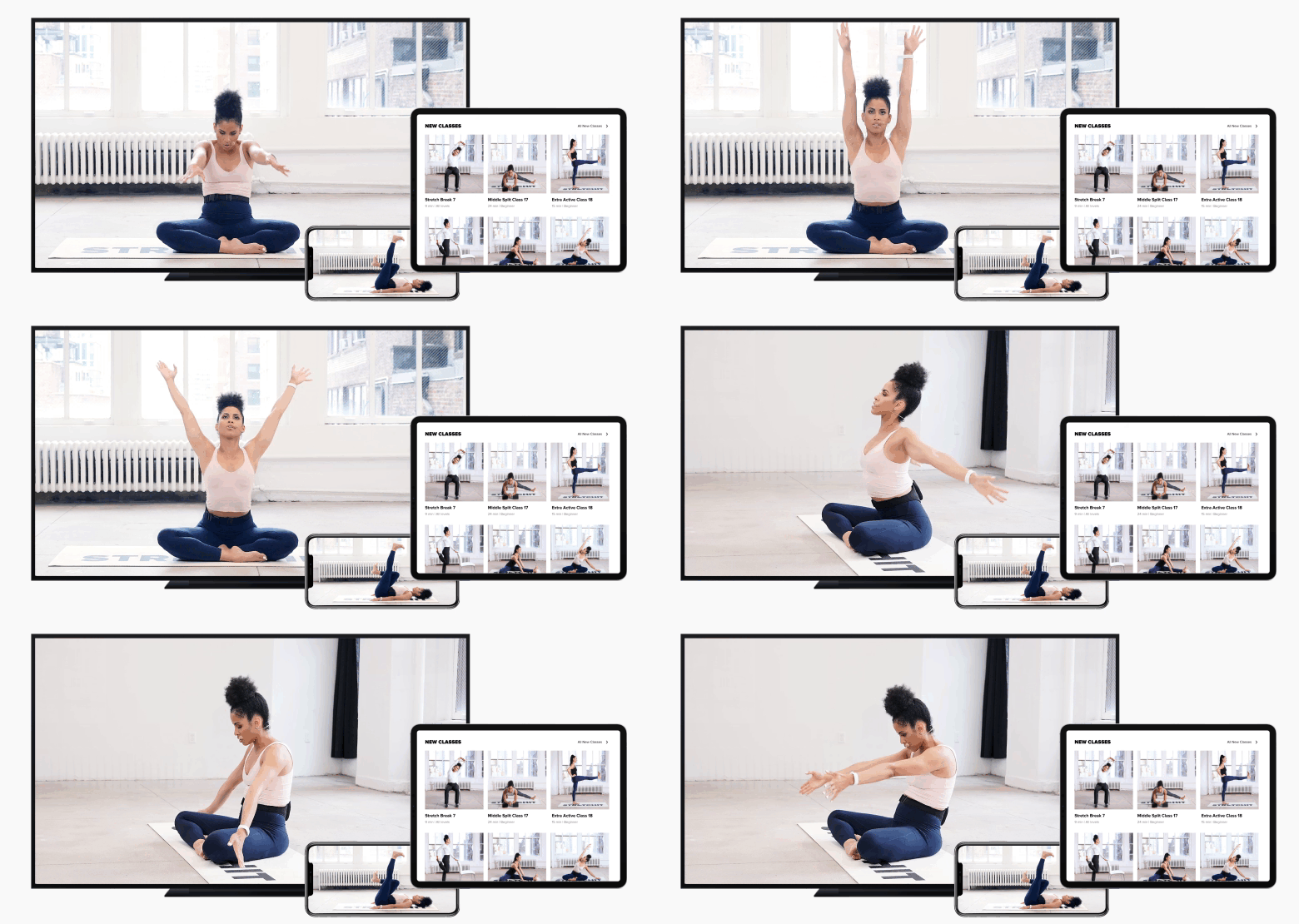
In the STRETCHIT app, start with Forward Fold Variations and Pike Stretch in STRETCHIT Fundamentals. For a longer guided sequence, try Hamstring Express classes with Alicia Archer. The classes include alignment guidance, modifications, and prop options for different starting points.
Get started with STRETCHIT and choose a class that matches your current flexibility and experience.
Resources
- Mayorga-Vega, D., Merino-Marban, R., & Viciana, J. “Criterion-Related Validity of Sit-and-Reach Tests for Estimating Hamstring and Lumbar Extensibility: A Meta-Analysis.” Journal of Sports Science and Medicine, 2014.
- Ayala, F., Sainz de Baranda, P., De Ste Croix, M., & Santonja, F. “Reproducibility and Criterion-Related Validity of the Sit and Reach Test and Toe Touch Test for Estimating Hamstring Flexibility in Recreationally Active Young Adults.” Physical Therapy in Sport, 2012.
- Ingram, L. A., Tomkinson, G. R., d'Unienville, N. M. A., et al. “Mechanisms Underlying Range of Motion Improvements Following Acute and Chronic Static Stretching: A Systematic Review, Meta-Analysis and Multivariate Meta-Regression.” Sports Medicine, 2025.